In Collaboration with Adena Rissman, Professor of the Human Dimensions of Ecosystem Management, University of Wisconsin – Madison
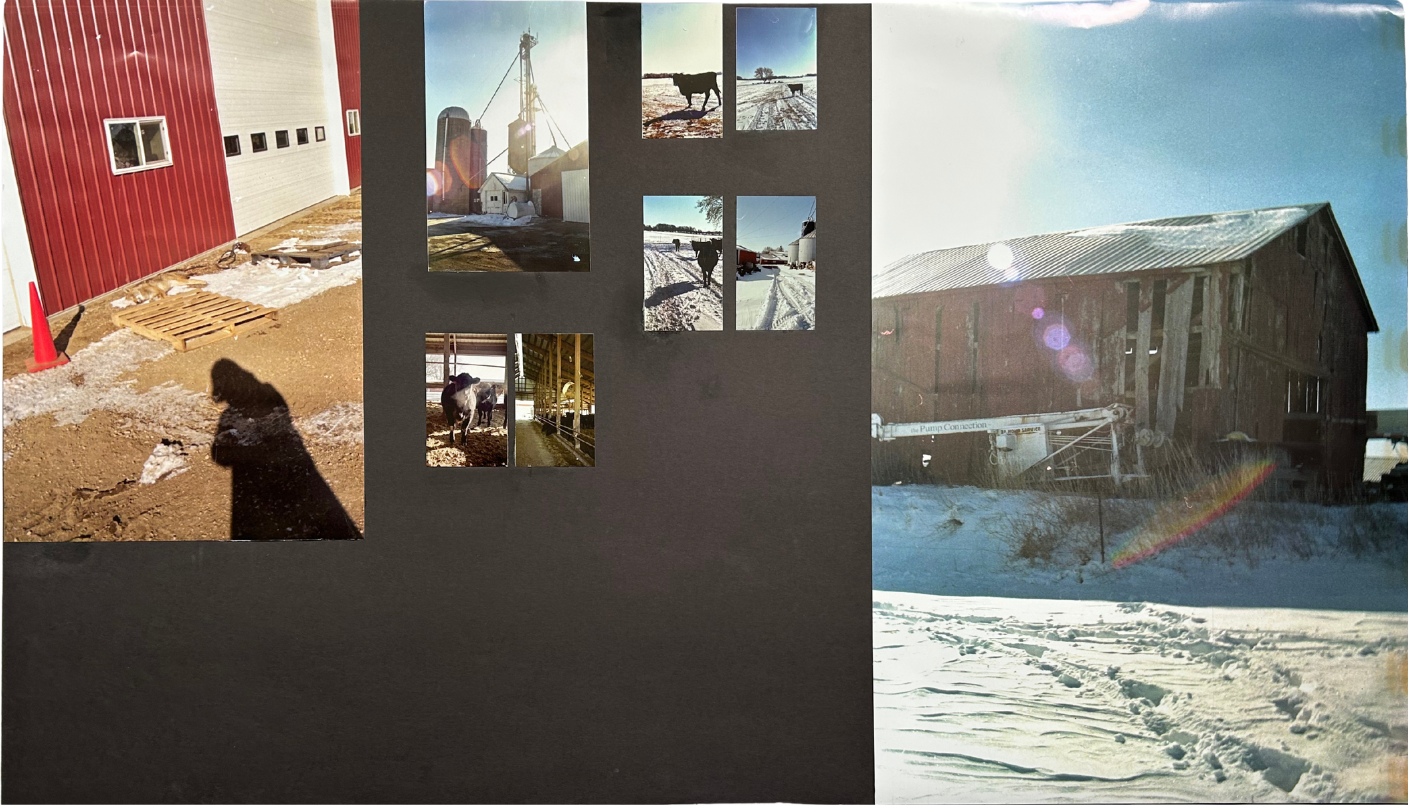
These multiple prints hold deep meaning for me. The angles of light converging toward the center of the piece were inspired by clerestory windows. The absence of people in the images highlights how disconnected humans are from the active process of runoff—an essential yet largely unmonitored occurrence. While we have some control over it, runoff only becomes a problem once it directly affects our water.
The subject in all of my work is representing human expression by perspective and by non-verbal means. I create photographs that explore the humanistic relationships between people and their environments. My work is driven by a love for fleeting expressions, harsh grain, and the uncommon moments found in casual American life. Notably, I capture subjects blending into their surroundings, or notably composing to remove people from images, as if the connection between buildings, forests, and streets inherently calls for the people who inhabit them.
ABOUT THE ARTIST
Abe Randle is a student at UW-Madison.
ABOUT THE WATER PARTNER
Adena Rissman is a Vilas Distinguished Achievement Professor of the Human Dimensions of Ecosystem Management in the Department of Forest and Wildlife Ecology at the University of Wisconsin–Madison. She is an affiliate faculty of the Nelson Institute of Environmental Studies, Community and Environmental Sociology, Robert M. La Follette School of Public Affairs, Holtz Center for Science and Technology Studies, and Agroecology program.
My interdisciplinary research investigates the relationships between society and the environment in ecosystem management, conservation, and sustainable use. I investigate institutional approaches to conservation and new models of environmental governance. My research employs mixed quantitative and qualitative methods including spatial analysis, surveys, and interviews.