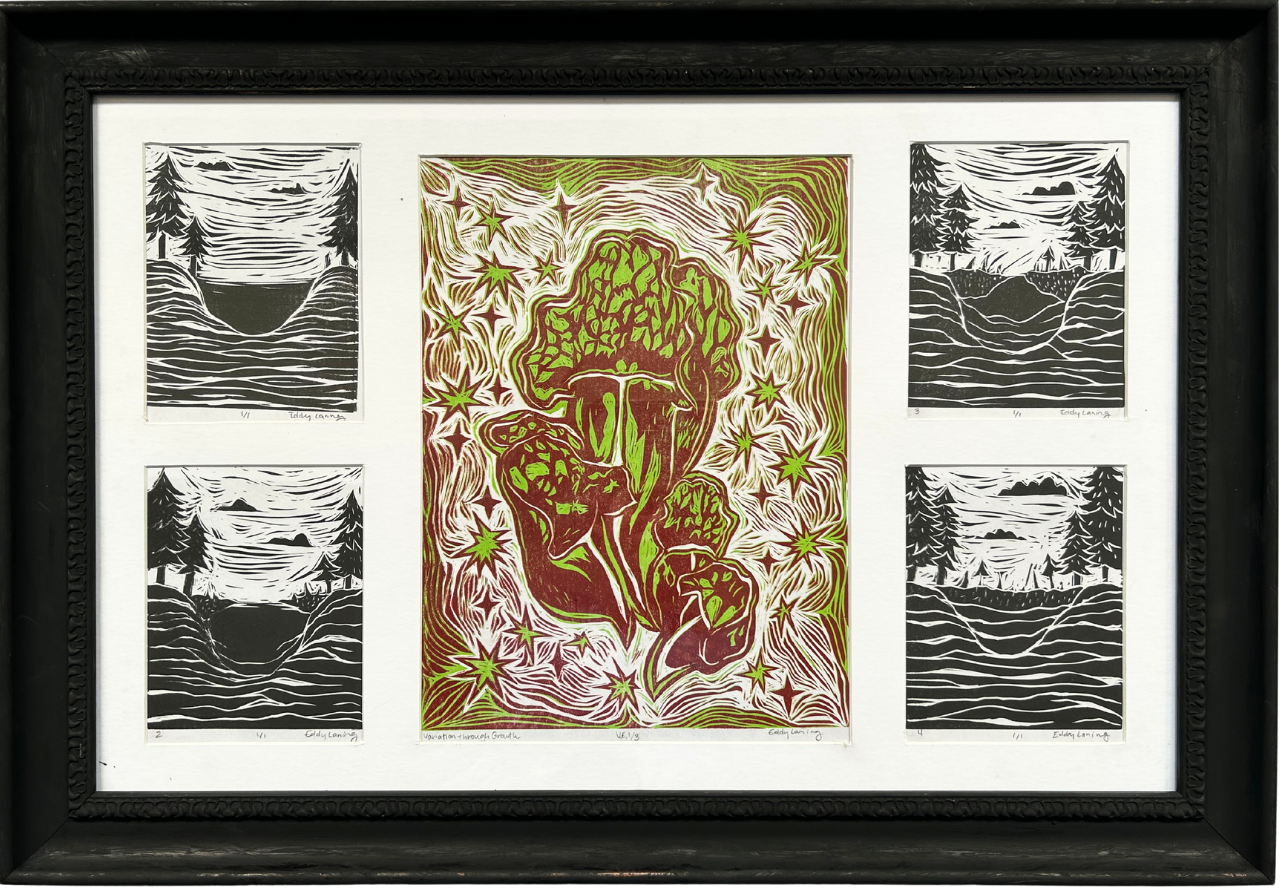
16″ x 24″ Linocut print on Masa paper In Collaboration with Sara Hotchkiss Ph. D., Professor of Botany, University of Wisconsin-Madison
Sara’s work greatly inspired me, her work engages with peat bogs in Northern Wisconsin. I had no idea there were any bogs in Wisconsin, I thought those were more prevalent in more tropical climates. Her work and images she took showed me that Wisconsin can foster much more beauty than I imagined. With pitcher plants and peat mosses, with a myriad of greens, yellows, maroons, and purples, and the colorful layers of browns in the mud and clay, they display thousands of years worth of variation.
This piece started as blank linoleum but, over time, became so much more. What idea started as a triptych of mosses and their colors became a quintych with one large piece with both mosses and pitcher plants, the smaller pieces being renditions of peat formations taking over kettles. The main piece is a reduction print meaning that the first layer was printed in green and then I carved the linoleum again and printed the burgundy.
This idea was brought to life with the help of my printmaking professor Lisa Wicka. I felt it necessary to show the beautiful colors of the moss and pitcher plants so this reduction method was pivotal. I hope the viewer can understand my admiration for the work Sara Hotchkiss is doing as well as learn about the vast environment of Wisconsin.
ABOUT THE ARTIST
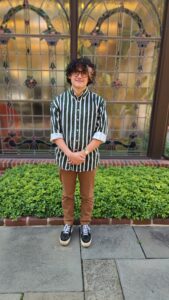
Eddy Laning is an undergraduate attending UW-Green Bay for human biology and studio arts. He works with many mediums but is emphasizing in painting, printmaking, and drawing. He currently works with Lisa Wicka to maintain her studio, while he tests out new techniques and helps out with the introductory printmaking class.
His goal is to be a tattoo artist while still submitting his artwork into galleries and exhibitions.
ABOUT THE WATER PARTNER
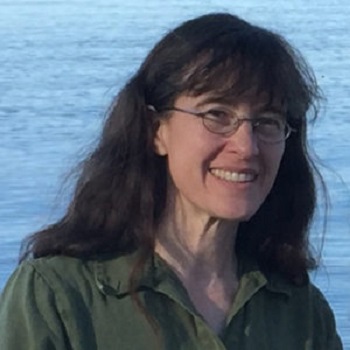
Our research group is collaborative and interdisciplinary, working mostly in Hawaii and the western Great Lakes region. We seek perspective on ecological systems through time and space, finding examples of processess that occur too slowly or events that occur too rarely for humans to easily observe. Our current research examines ecological responses to species invasion, multidecadal droughts, and changes in fire regimes across landscapes and in the sedimentary records left by aquatic communities and their watersheds.