Please do not use image without permission from artist.
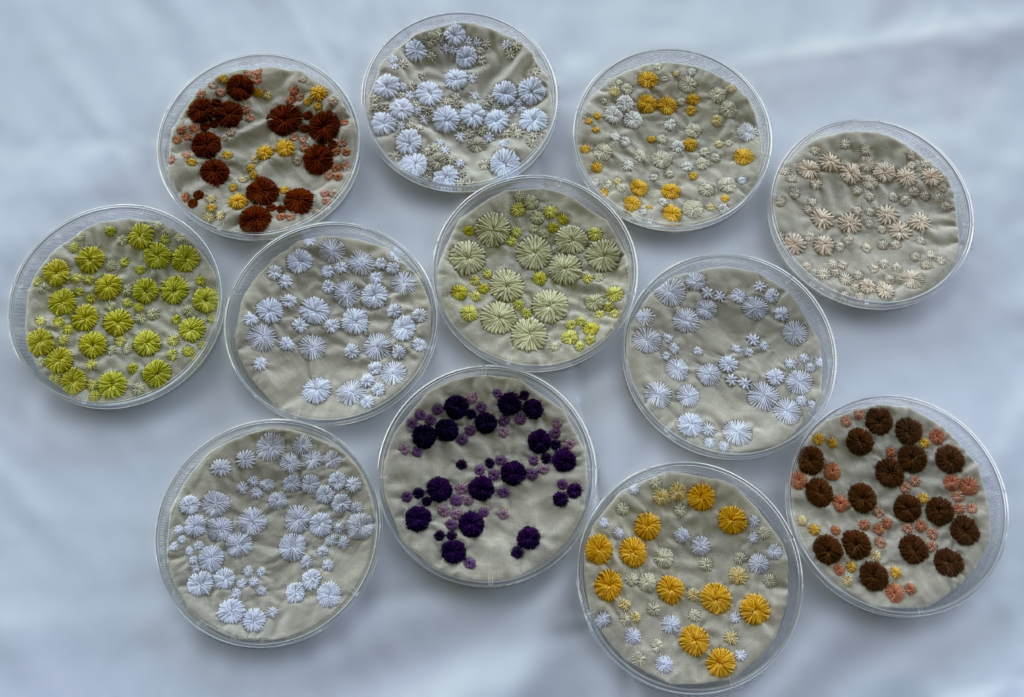
Mendota’s Microbial Community
Twelve 4.5” Diameter Petri Dishes
Fabric & Threads in Plastic Petri Dishes
In Collaboration with Amanda Appel, PhD Student in the Microbiology Program at the University of Wisconsin – Madison
Amanda’s research is fueled by the possibility of expanding human use of bacterial polysaccharides as sustainable polymers with a wide range of applications. Bacterial exopolysaccharides are sugar chains that bacteria secrete into their microenvironment. Exopolysaccharides can make for a stickier environment, preventing the loss of nutrients to the flow of water.
She collects water samples from Lake Mendota, Madison, Wisconsin and enriches floating biofilms, then spreads the bacteria in these mixed communities onto the petri dishes to get a closer look at each individual. Once on the petri dish, each member from the floating biofilm can grow its own colony, or a clustered mass of a single bacterial species, and their growth and lifestyle can be observed. Enriching wild bacteria from local lakes leads to the plating and discovery of bacteria and unique colony morphologies, distant in their color, texture, and shape.
In a collaboration with Amanda, PaChoua uses hand sewing embroidery technique to recreate unique bacteria patterns onto the fabric. She used embroidery threads with different numbers of strands to create thickness in layers, textures, and patterns. Color palette from each of the petri dish pieces are inspired from Amanda’s personal petri dish collection she grew in her lab. The colors distinguish the different types of bacterial colonies.
ABOUT THE ARTIST
PaChoua Yang
University of Wisconsin – Stevens Point
ABOUT THE WATER PARTNER
Amanda Appel
PhD Student in the Microbiology Program at the University of Wisconsin – Madison